

- VA construction loans are short-term and offered as one-time or two-time close options.
- The builder must be VA-approved, and the home must meet VA property standards.
- Most lenders, including Veterans United Home Loans, don’t fund the construction phase.
VA construction loans can help qualified Veterans finance the purchase of land and the construction of a brand-new home without a down payment.
A true 0% down VA construction loan isn't common in today's lending climate. Many lenders, including Veterans United, don't fund the actual construction of the house. Instead, Veterans United can refinance a construction loan into a permanent VA loan after the construction is complete.
Starting with a standard construction loan and then refinancing into a VA loan is a common route among borrowers and lenders.
What is a VA Construction Loan?
A VA construction loan is a short-term loan allowing Veterans to purchase land and build a custom home as their primary residence. There are two types of VA construction loans: the one-time close and the two-time close.
When you get a VA construction loan, whether it involves two closings or is bundled into one, the lender typically disburses funds to the builder in stages (called draws) as construction progresses. Once the house is finished, you transition to the permanent VA loan.
VA One-Time Close Construction Loan
For a VA one-time-close construction loan, the construction and permanent financing are handled with a single loan at closing, before construction commences.
Your interest rate locks at the initial closing, protecting you from market changes during the build, and there's no need to requalify or pay a second set of closing costs when construction wraps up. The loan automatically converts to a permanent VA mortgage after construction is complete.
If you’re planning to use a VA refinance later on, the VA’s seasoning requirement doesn’t start until the loan converts to permanent financing. From there, you’ll need to wait at least 210 days from the due date of your first mortgage payment and make six consecutive, on-time monthly payments before you're eligible to refinance.
VA Two-Time Close Construction Loan
In a two-closing setup, there are two separate closings (and associated closing costs), one for the VA construction financing and one for the permanent mortgage. In this setup, the second closing finalizes the VA loan, which is used to pay off the short-term construction loan.
Keep in mind that the VA itself doesn’t offer any type of construction loans. A VA construction loan is a loan made by private lenders that the VA insures.
VA Construction Loan Requirements
You’ll need to meet all the standard VA loan eligibility requirements to qualify for a VA new construction loan, as well as some additional ones you wouldn’t run into in the typical VA loan home purchase.
VA loan new construction requirements include:
- Finding a licensed and insured builder that fits your needs (a VA Builder ID is no longer required for new or proposed construction)
- Submitting a complete set of construction plans to your lender when applying
- Appraising the home construction plans
- Providing any additional documentation your lender may require, usually, this will include the materials involved in the construction
- Lenders typically require a 620 minimum credit score, though some may require 640+ due to the increased risk of construction debt
- While Veterans with full entitlement face no traditional loan limits, those with partial entitlement are subject to the 2026 conforming loan limit of $832,750 for standard counties
VA Construction Loan Uses
Veterans can use a VA construction loan to build a single-family home on land they own or plan to purchase. However, the VA has restrictions on using the VA loan to purchase land. Veterans can't buy land with a VA loan unless they immediately begin construction after purchase.
What is the VA Construction Loan Process?
Every homebuyer’s situation looks different, depending in part on the lender they’re working with, the home builder and a host of other factors.
Generally, the process follows along these lines:
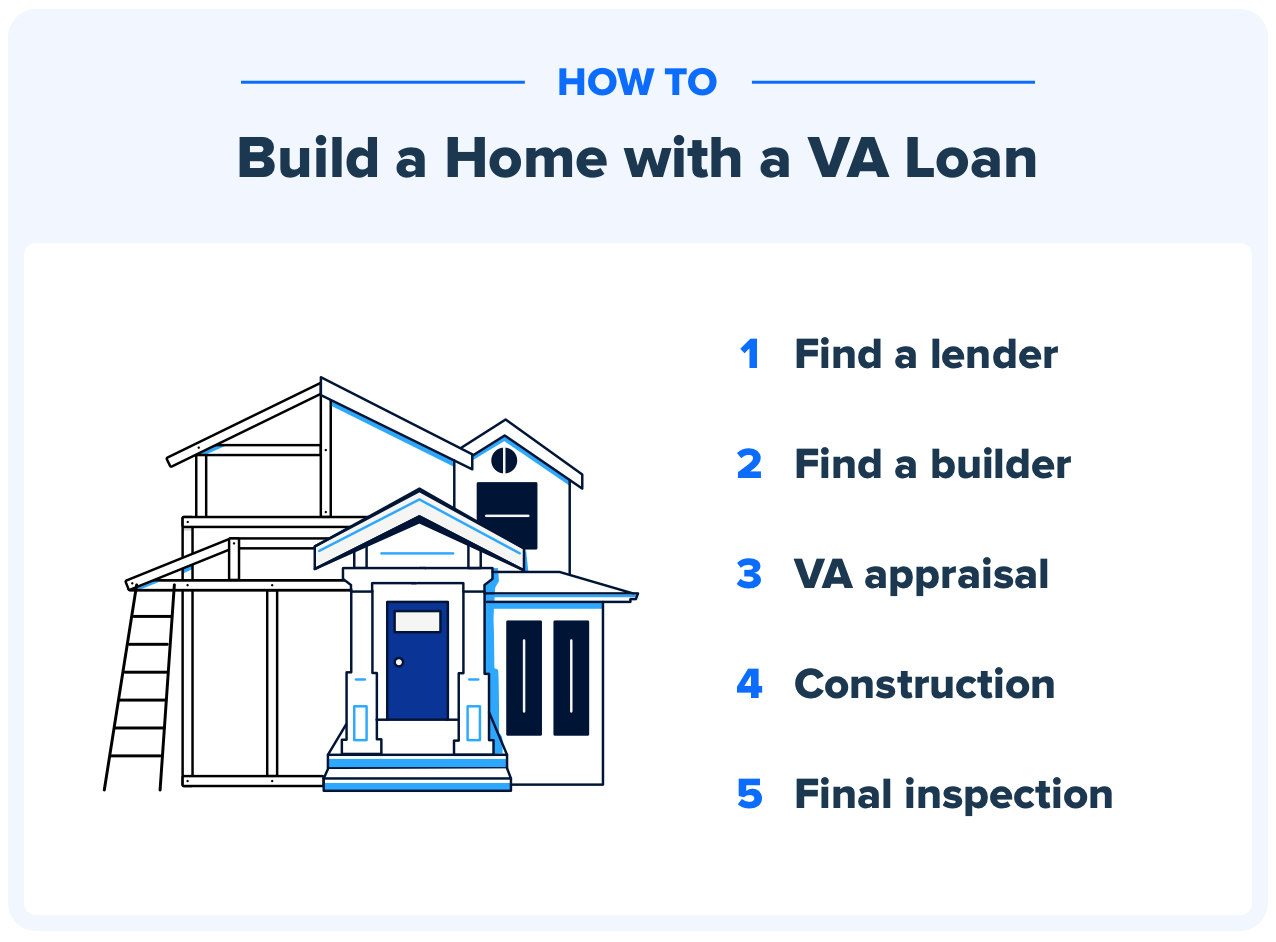
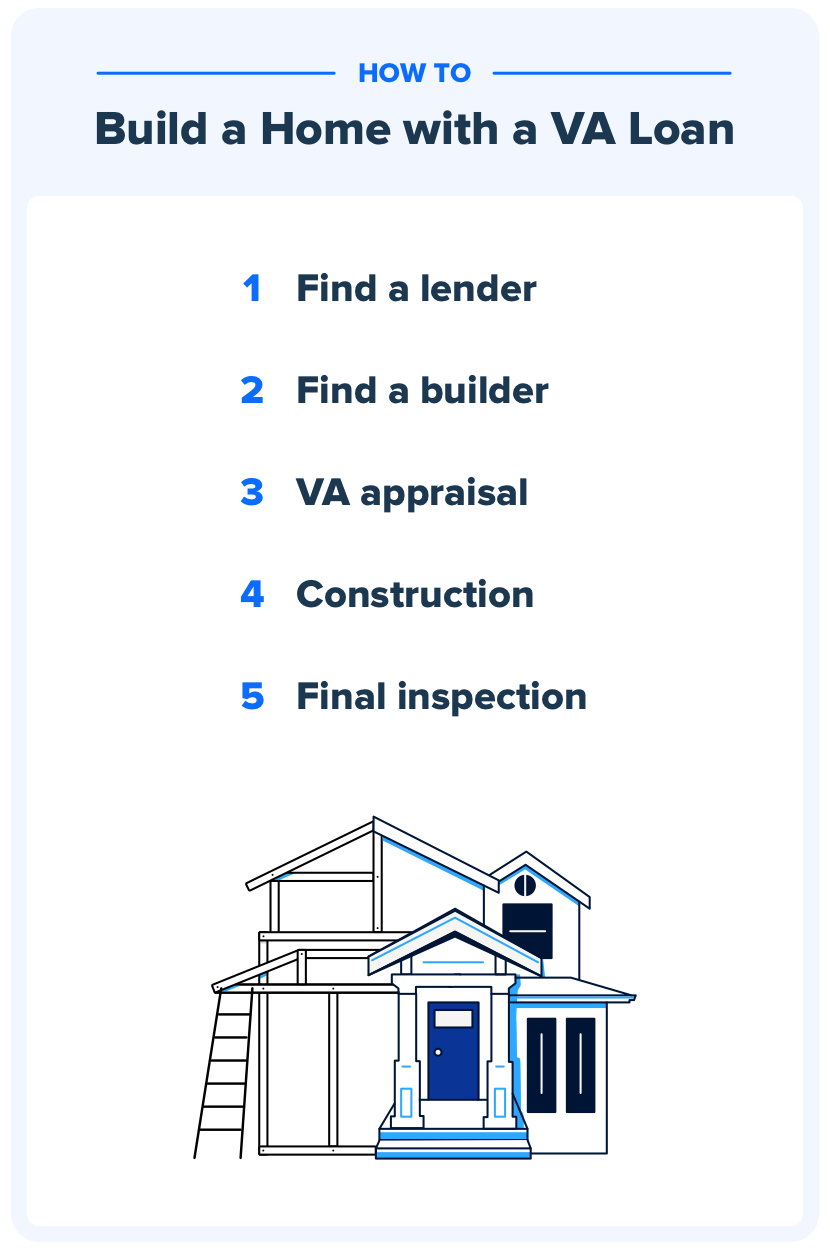
Step 1: Find a Lender
This first step can prove challenging. Many VA lenders do not offer financing for new construction. We’ll explore other ways to use your VA loan benefit to build a home in the next section.
Credit score requirements, interest rates and other variables can and often will vary among lenders. If you find a trustworthy lender offering these loans, then you’ll work with them to close the loan before construction starts. That means providing the same kind of income, employment and financial information you would for a traditional VA purchase loan.
Step 2: Find a Builder
The VA no longer requires builders to register for a VA Builder ID. However, it’s still important to choose a reputable, experienced builder who’s familiar with VA loan requirements for new construction. If you need help finding a builder, the VA maintains a list of its registered home builders on its Loan Guaranty Hub.
Your builder will need to provide the construction plans and other documentation to your lender for approval. To avoid delays, look for builders who have experience working with VA loans or are open to collaborating with VA-approved lenders.
Step 3: VA Appraisal
The lender will order a VA appraisal based on the new build plans and specifications. Soon after, the VA issues the formal Notice of Value listing the home’s fair market value. Lenders will lend the lesser of the home’s acquisition costs and its fair market value. Once this key step is complete and the proposed home meets VA guidelines, your loan can move to closing.
Step 4: Construction
With a true VA construction loan, Veterans close on the loan before the build begins. The lender then makes draws to a builder to cover the stages of new home construction. The builder pays for the closing costs and interest during closing, but they can include these costs in their agreement with the borrower to build.
Step 5: Final Inspection
The VA requires a final inspection when the home is complete. The original appraiser typically conducts the final inspection whenever possible. This inspection ensures the home still meets VA's broad property condition guidelines (Minimum Property Requirements) and was built to the correct plans and specs.
-
“Choosing a lender that has experience with VA construction loans is very important. This loan type can be more complex than a traditional loan so having a knowledgeable lender help navigate times, draw schedules and paperwork correctly from the beginning is crucial.”
 Carrie FreemanAssociate Director of Production - NMLS #1140687
Carrie is an Associate Director of Production at Veterans United, where she supports a team of Loan Officers and brings over 12 years of experience guiding Veterans through the homebuying journey.
How to Find a VA Construction Loan Lender
Not every VA-approved lender offers construction financing, and among those that do, experience with the VA loan process itself matters just as much as the construction product they offer.
A lender who is experienced with VA loans will have a much deeper understanding of VA guidelines, appraisal requirements and what it takes to get a loan to the finish line. That familiarity becomes even more important when the complexity of construction financing is layered on top.
A VA one-time close construction loan carries more risk for the lender than a traditional VA purchase loan. Even if a lender provides this specific loan product, the inherent risks remain. This often means more demanding credit scores, higher interest rates, or reduced builder flexibility.
For some Veterans, the simplicity of one closing outweighs those tradeoffs.
For others, starting with a traditional construction loan from a builder or a local lender and then refinancing into a permanent VA loan at the end is the smarter path. This approach is something we help Veterans with every month.
Another Option: Starting With Standard Construction and Refinancing Into a VA Loan
Veterans unable to find a lender willing to finance a true VA construction loan can apply for a traditional construction loan and transition to a VA loan after closing.
Getting a traditional construction loan often requires a down payment. However, it may be possible to recoup the down payment in some cases.
When searching for a construction loan, it can pay to shop around. Talk with multiple builders and financial institutions and compare down payment requirements, closing cost estimates and more.
Some builders may have programs or deals, especially for Veterans and military families. Do your homework and make sure you're working with a legitimate builder with a track record of success and satisfied homeowners.
Veterans and military members who own the land they want to build on may be able to use any equity they have toward down payment requirements for construction financing.
Veterans who don't already own land can often include purchasing it in their overall construction loan.
It's important to understand that construction loans are short-term loans. That means Veterans and military members must start working on the permanent financing as early as possible.
Ideally, you should communicate with a VA lender from the very beginning, so you’re both prepared to switch to permanent financing once the construction is complete.
Permanent VA Financing for Construction Loans
Lenders can take a couple of different approaches to turn that short-term construction loan into a permanent VA loan. One is to issue a VA purchase loan, and the other is to make a VA Cash-Out refinance loan. Guidelines and policies on this can vary by lender.
From an underwriting perspective, there's little difference between a VA purchase and a VA Cash-Out refinance. In both instances, Veterans and military members hoping to turn their construction loan into a permanent VA mortgage will need to meet the same underwriting guidelines as Veterans purchasing an existing home. This includes meeting requirements for credit score, debt-to-income ratio, residual income and more.
Additionally, the home needs to be constructed by a licensed and insured builder. Obtaining these credentials is straightforward, and it's even possible for Veterans to build the home themselves. Builders often need to provide a one-year warranty.
Lining up a construction loan is a critical step, but you'll need to turn that short-term loan into a long-term mortgage once the home is built. That's not something you want to wait to explore.
New Construction Purchase vs. Cash-Out Refinance
The big difference between VA purchase and VA Cash-Out refinance loans is your ability to get cash back at closing.
With a VA purchase loan, lenders will lend the lesser of the home's appraised value and the total payoff for the home's construction (and the land loan if that amount isn't included in the construction loan).
On a cash-out refinance, qualified buyers may be able to borrow up to 100 percent of the home's appraised value. That means Veterans and military members may be able to get cash back at closing from the home's equity, which could help defray the upfront cost of a down payment or other cash outlays.
For example, let's say you put down 10% to secure a $300,000 construction loan to cover the land acquisition and the construction of the new home. Subtract the down payment ($30,000), and you're left needing to borrow $270,000 to repay the construction loan.
If the VA appraisal ultimately determines the home's value is $300,000, you might be able to borrow that amount and get back in cash the difference between the appraised value and what you owe ($30,000 in this example).
Guidelines on the loan-to-value ratio and other requirements can vary by lender.
Generally, the borrower needs to hold title to the land on which the home is built in order to be eligible for a refinance. Otherwise, Veterans United would treat it as a purchase loan.
Some buyers may jump at this cash-back opportunity, while others prefer to keep building equity and start with the smaller loan balance. Every buyer's situation is different.
Some Veterans Consider Building With Limited Inventory
While housing inventory has improved from the record lows of recent years, many Veterans and service members are still considering new construction to expand their homebuying options in competitive markets.
This issue remains a major barrier for buyers, with about 20% citing a lack of housing inventory as holding them back in Q2 2026, according to a recent national survey of Veterans and service members with near-term homebuying plans.
Veterans cited high home prices and interest rates as the largest barriers to buying a home from Q1 2025 through Q2 2026. While both have trended downward over that period, housing inventory concerns have remained flat. Meaning the lack of available homes remains a persistent problem for buyers, even as other barriers ease.
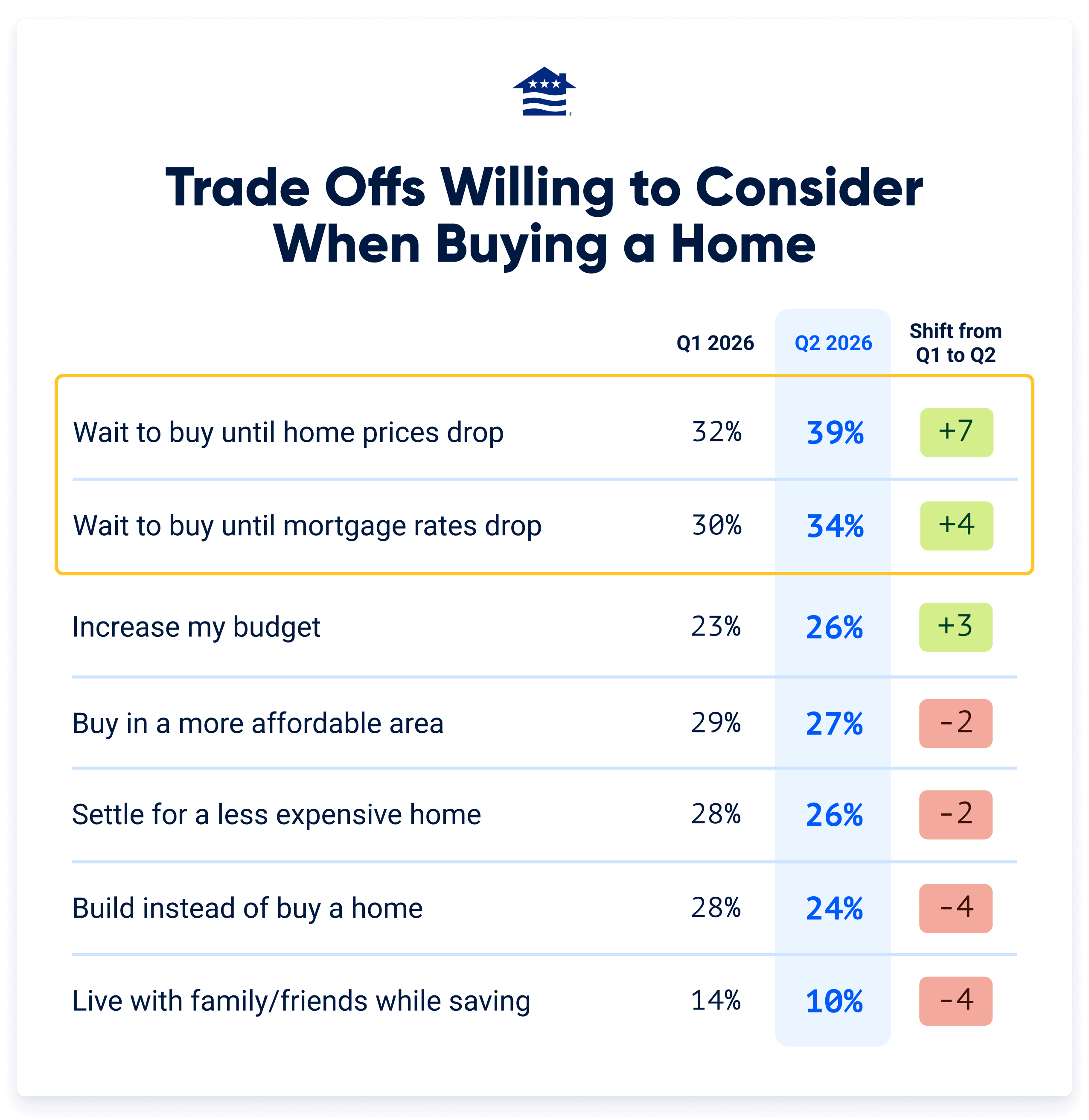
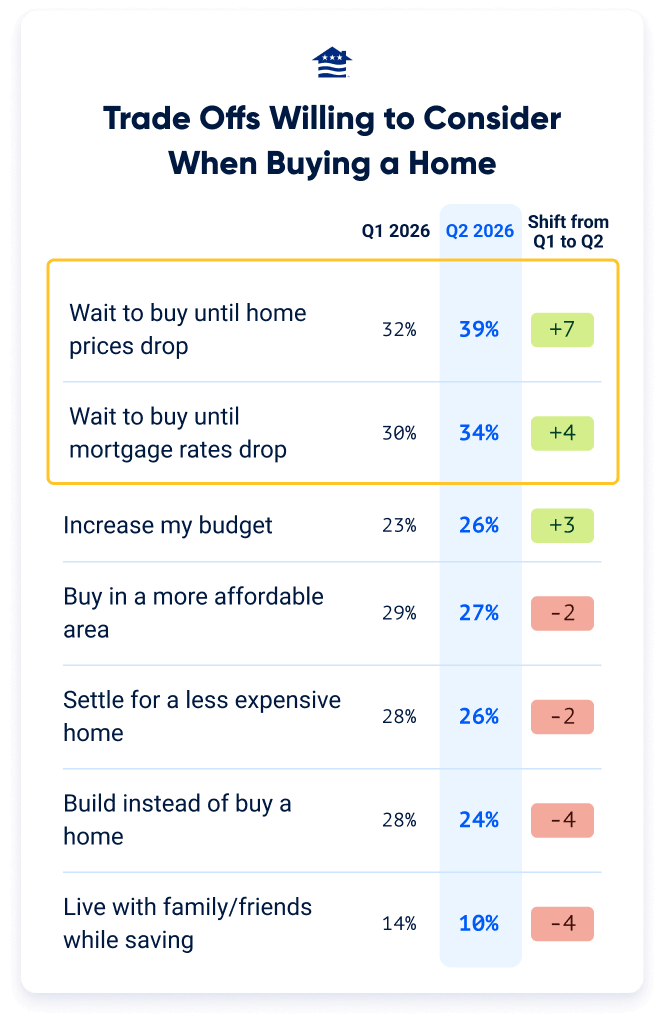
Building a new home is one of the top six trade-offs Veterans and service members are willing to make given the inventory shortage, according to a quarterly national survey of Veterans, service members and civilians who intend to buy homes in the next three years.*
Here’s a look at the top compromises Veterans are willing to make:
It is absolutely possible to use your VA loan benefits for new construction. But the process isn't always simple or straightforward, and some buyers may need money for a down payment to get things moving.
Building a home is a big decision, and one that you don’t need to make alone. Connect with a Veterans United VA loan expert to talk through your construction loan options!
*Survey Methodology
A national survey of 859 respondents conducted June 1 – 17, 2026, including Veterans and service members, civilians and Veterans United in-process borrowers. The survey was conducted by data and analytics firm Sparketing on behalf of Mortgage Research Center, LLC.
How We Maintain Content Accuracy
Our mortgage experts continuously track industry trends, regulatory changes, and market conditions to keep our information accurate and relevant. We update our articles whenever new insights or updates become available to help you make informed homebuying and selling decisions.
Current Version
Sep 18, 2026
Written ByChris Birk
Reviewed ByDon Wilson
Updated data figures and copy to reflect the 2026 Veteran Homebuyer Report.
Jun 20, 2025
Written ByChris Birk
Reviewed ByDon Wilson
Updated data figures and copy to reflect the 2025 Veteran Homebuyer Report.
Jun 19, 2025
Written ByChris Birk
Reviewed ByDon Wilson
Added expert insight about VA construction loans.
Apr 3, 2025
Written ByChris Birk
Reviewed ByDon Wilson
Updated to reflect that VA Builder IDs are no longer required.
Dec 12, 2024
Written ByChris Birk
Reviewed ByDon Wilson
Added additional content to fully explain the one-time close and two-closing VA constructions loans and enhance content for the construction-to-refinance alternative. Added an updated Q3 2024 data analysis of homebuyers facing a low-inventory market and how it's relevant to the construction loan. Fact-checked and reviewed by underwriter Don Wilson.
Veterans United often cites authoritative third-party sources to provide context, verify claims, and ensure accuracy in our content. Our commitment to delivering clear, factual, and unbiased information guides every piece we publish. Learn more about our editorial standards and how we work to serve Veterans and military families with trust and transparency.

Related Posts
-
 VA Renovation Loans for Rehab & Home ImprovementVA rehab and renovation loans are the VA's answer to an aging housing market in the United States. Here we dive into this unique loan type and the potential downsides accompanying them.
 -
 How to Get a VA Loan as a Reserve or National Guard MemberNational Guard and Reserve members can also get a VA home loan. Learn more about eligibility, income standards, required documentation and more


